Grounding Beats Prompting
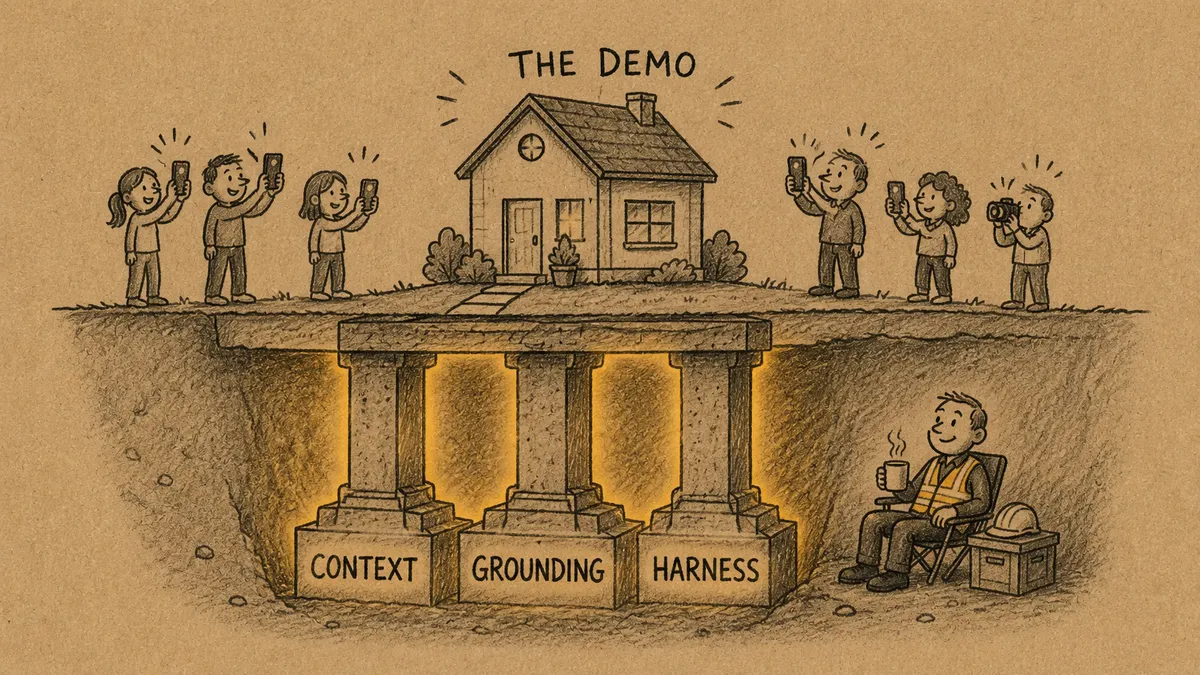
In 2023 I bought a new-build house. I was convinced it would never be finished in time for the completion date. Every time I drove past it was a shell with some pipes and rubble lying around and if you were lucky, a man in a hi-vis having a cup of tea. Nothing, as far as I could see, was happening. I had a moving date and a growing sense of dread.
Then, more or less overnight, there was a house. Walls, a roof, concrete floors, the lot. The three months of apparently nothing turned out to be the part that mattered. The foundations and the groundwork were the house. They just had not surfaced yet.
Building software with AI feels the same. The work that counts happens before anything is visible. And it is often where most people starting out get it wrong.
Context is the work
The visible build with AI is fast and a little bit dramatic. You watch screens appear, code write itself, a thing come to life in a morning. That part gets all the attention. It is the walls going up, the roof going on.
The less glamorous part is the groundwork.
First there is the context: the materials and the plans - everything true about what you are building, gathered in one place. The data, the rules, the examples of what good looks like.
Then there is the grounding: pouring that context into the foundations, anchoring the model in what is real so it builds on solid ground instead of its own guesses.
And there is the harness: the site itself - the services run into the plot, the scaffolding around it, the apparatus that lets the walls go up fast and safely once the foundations are in.
While all three are going in, it looks like nothing is happening. No demo. No screens. Just files, and someone in a hi-vis having a cup of tea.
Grounding is the one that does the heavy lifting, so it is the one to be clear about. Grounding is giving the model the contextual material to work from instead of a clever sentence and a hope. Ask an ungrounded model to “build me an onboarding flow” and it will invent one out of thin air - it is why I have started calling the maker portal vibe.powerapps.com. Ask the same thing on top of your actual data model, your real rules, and three examples of flows you already like, and you get something you can use. Same request. Wildly different result. The only thing that changed was the ground it stood on.
Organising Information
Forget dark arts and machine learning - this is old-fashioned information organisation. Back to basics - taxonomy, folder structure and generally being organised and not saving everything onto your Windows desktop.
The skill that makes AI sing is the deeply unglamorous one of laying out what you know so that something else can find it, trust it, and not contradict it. It is closer to librarianship than wizardry. The people who are brilliant with AI right now are very often just the people who were always tidy with information. They wrote things down. They named things well. They kept a clean source of truth. It turns out we were building that muscle for a reader we did not know was coming.
I spent years thinking that kind of work was overhead. The boring bit before the real engineering. It was the foundations all along.
Prompts are the easy bit
Meanwhile, almost all the noise is about the other half. The internet is awash with prompt tricks: the magic phrasing, the secret system message, the “act as a senior architect” incantations. And look, prompting matters a little. But a mediocre prompt on excellent grounding beats a brilliant prompt on nothing, every time. Prompts are the front door everyone admires. Grounding is the foundation nobody photographs.
You can see it most clearly when grounding is thin, because you get drift. Drift is the model’s output slowly wandering away from what you actually meant, confidently, because you left gaps and it filled them with guesses. Tell it to keep something “consistent with our existing style” without ever showing it that style, and it will invent a style of its own and then defend it to the death. The fix for drift is almost never a cleverer prompt. It is better grounding. Show it the thing. Close the gap it was guessing into.
Do the digging
For three months my house looked like a muddy hole and I lost sleep over it. It was the most important phase of the whole build. The work that decides whether the thing stands up is the work you cannot see yet.
AI is no different. The groundwork, organising your information, writing down what is true, grounding the model in reality, is not the boring prelude to the work. It is the work. The afternoon where the screens appear is just the walls going up on top of it.
So stop polishing prompts. Go and organise your information. That is where the house gets built.
Did you find this post helpful?
A little support goes a long way in helping me create more free, in-depth content like this.