Intern or Master?
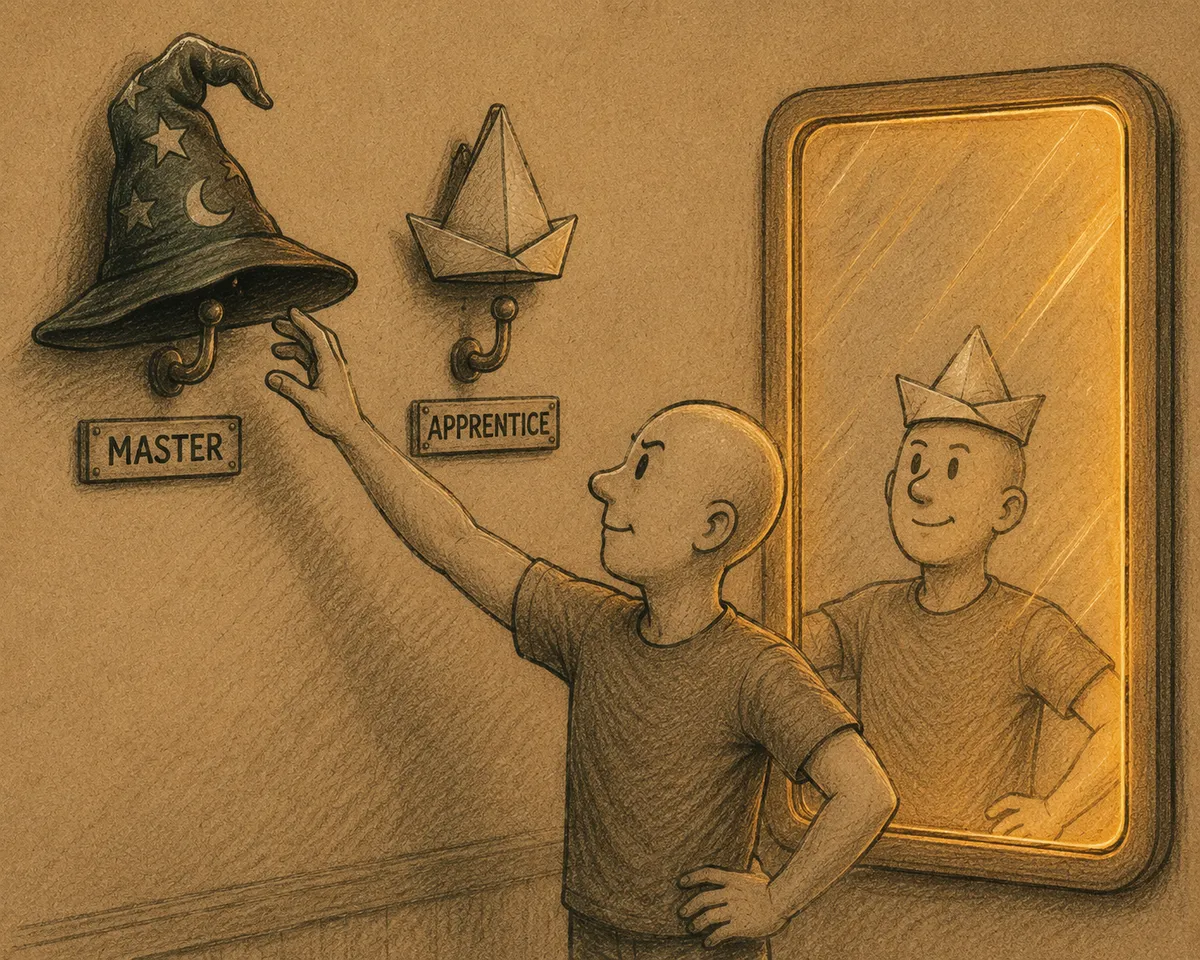
As a child, I watched Star Wars on a rented VHS more times than was healthy, and one line lodged itself in my head. Darth Vader, lightsaber drawn, facing down old Obi-Wan: “When I left you I was but the learner. Now, I am the master.”
As a kid it was just a great menacing line when playing with toy lightsabers. Years on, it has turned into a surprisingly useful way to think about working with AI.
Which one are you today?
Every time you sit down with one of these tools, there is a question underneath the work: which of you is the master, and which is the learner? The unsettling part is that the answer changes constantly, sometimes within the same afternoon.
When the work is in your own field, the framing that helps most is to treat AI like a brilliant intern. It is fast, tireless, alarmingly well read, occasionally overconfident, and it needs supervising. You give the direction, it does the heavy lifting, you read its work and catch the howlers before they ship. You are the master, and it is the gifted intern who will go far once it learns not to make things up. That works beautifully. As long as you really are the master.
When the roles flip
Now step off your patch, into a language you never learned or a domain that was never yours, and the roles flip without asking your permission. AI is the master now, and you are the apprentice.
This master is always available and never sighs. It never makes you feel stupid for asking the same question twice, and it will explain the same idea five different ways at one o’clock in the morning. The apprenticeship that used to take years could take days.
I am a Microsoft person by trade. Python was never my language. A couple of years ago, learning it might have meant months of false starts and a stack of half-read books. The classic course was Learn Python The Hard Way, and the method was in the name: you typed every line out yourself, no copy and paste, because the typing was the learning. The friction was the point.
Today, with a patient master on tap, you can go from fumbling to a ‘working’ program in under a minute. But a program that runs is not the same as a language you have learned, and the new master will happily give you one without the other. The learning is still on offer - you just have to ask for it now. So I did. I had it explain every line and justify every choice, and I pasted nothing I could not explain myself. Slower than a minute, still faster than the stack of books - and the whole way through, I knew exactly which one of us was the master.
The danger is not knowing
Everyone ends up the apprentice sometimes; that part is fine. The danger is being the apprentice without realising it, and carrying on giving orders as though you were still the master.
So the entire skill is knowing which hat you have on for this particular task. As the master, you supervise and you catch. As the apprentice, you stay humble, you verify, and you learn fast, because the swap from learner to master happens quicker than it ever has.
Be honest about today
In my own field, I can comfortably treat AI as the very able intern, doing the hard yards while I steer and check. The moment I wander off my patch, I know that I am the one being taught.
So I try to stay honest with myself about which one I am on any given task. Most of the expensive mistakes I have made with AI trace back to getting that wrong, usually because I assumed I was the master when I should have been the one asking the questions.
Did you find this post helpful?
A little support goes a long way in helping me create more free, in-depth content like this.