Communication As Programming
Over the last year, as AI models became better than ever, I kept catching myself leaning on the one qualification on my CV I had spent twenty years pretending wasn’t there.
I have a primary degree in Communication Studies and for most of my career in IT I often treated it as a slightly embarrassing footnote - the sort of thing you might mention at the end of an interview and hope nobody follows up on because it’s not real science. Two decades of writing code, thinking hard and arguing about architecture, and the qualification I ‘never used’ was the one about how people understand each other. Now I spend my best hours of the day doing the exact thing it was about - structuring a sentence so it cannot be misread.
Communication is the program
Building software has become an act of communication. The program is increasingly the words you write: the spec, the context, the instructions you hand the machine. The code still matters, but that is further downstream now. The models are the compiler. Get the words right and the code mostly follows. Get the words wrong and no amount of cleverness saves you. The language you use in Epics, Features, User Stories matters more now than ever.
So the most valuable technical skill right now is not a language or a framework. It is the ability to say precisely what you mean. Communication is the program.
Programming in English
Back in 2018, Tara Simpson wrote a piece called Programming in English. He argued there is almost a one-to-one correlation between people who write well and people who code well. At the time, before LLMs existed in the mainstream, this article really resonated with me. It read like an idea that was a little ahead of itself. It respected communication as much as code. Reading it now, it reads like a prediction of what was to become a more explicitly important skill as AI went mainstream in November 2022 and exploded in capabilities in November 2025. Five years after Tara’s piece, Andrej Karpathy put the same idea in a single line: “The hottest new programming language is English”. Perhaps Tara got there early.
The loop flipped
For thirty years the loop ran one way. You held the intent in your head and translated it, by hand, into something a computer would accept. The translation was the job we employed people to do. It was often slow, it was frequently awkward and hard to debug, and it rewarded people who were good at the translating and thinking required.
Since late last year that loop has flipped. I describe what I want in plain English, persist it as markdown, and the model does the translating. The skill has moved from syntax to specification. From knowing where the semicolon goes, to knowing exactly what you mean and being able to put it into words.
I watch this play out most days. Early on I might have prompted something like “build me a form to capture customer details,” and get back something confident and wrong. The model had guessed at half my decisions. When I went back and said who the form was for, which fields actually mattered, what counts as valid, and what should happen the moment someone hits submit, I got something I could use. Same model. Same five minutes. The only thing that had changed was how well I communicated.
The compiler used to forgive you
Coding was always communication. We just did it through a compiler, in a language so rigid that it hid the fact.
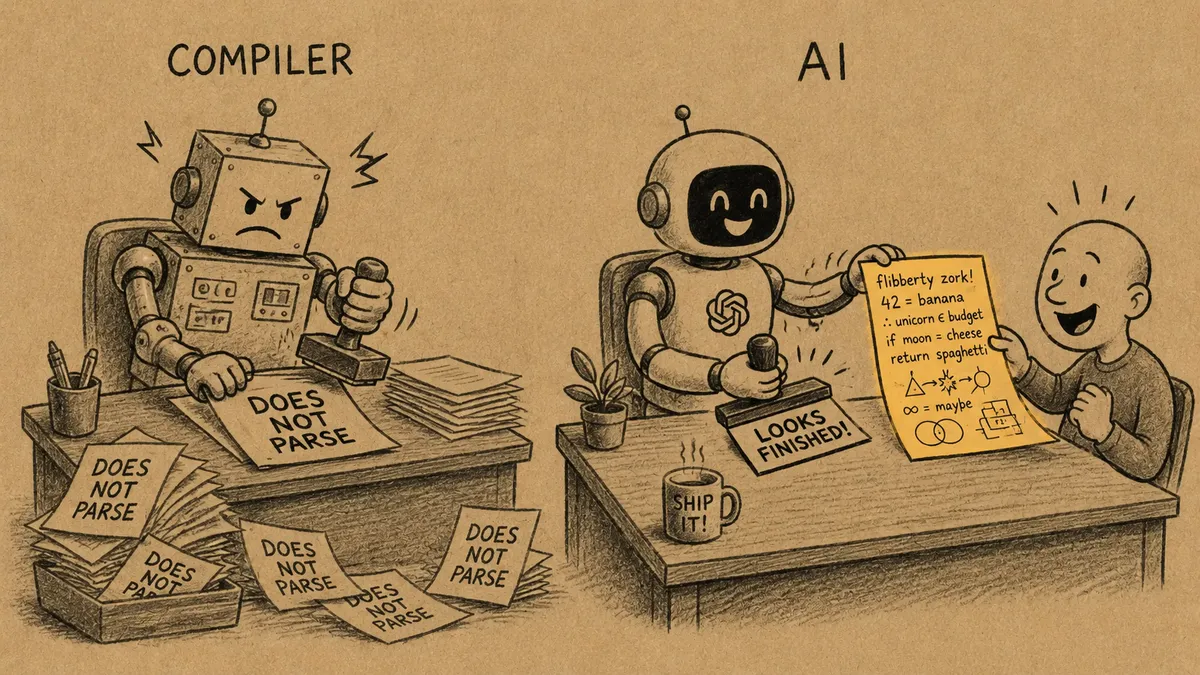
The compiler had one redeeming feature - it was a brutally honest editor. When your thinking was muddled, it failed loudly. A missing bracket, a type that did not line up, and it simply refused to run. Annoying at the time, but honest. It would not let you ship a sentence that did not parse.
The AI models are not that editor. Feed it something vague or half-considered and it will not stop and complain. It will confidently build the wrong thing, and make it look finished. Ambiguity used to be a compile error. Now it is a plausible, expensive mistake with nice formatting.
Who is good at this now?
This changes who is good at ‘tech’. The clear thinker who never got on with the syntax is suddenly dangerous, in the best way. “Can write code, can’t explain a thing” will stop being a thing people put up with.
We spent years telling the communicators they needed to get more technical, but we might have got that the wrong way round!
None of this is really new - in tech, our job was always about making yourself understood. We just had so much friction in the translation that we mistook the translation for the work. Take the friction away and what is left is the thing my old lecturers cared about. Can you say what you mean, clearly, to a reader who will take you completely literally.
The degree I used to skip past on my CV might now be the most useful thing on it. The model is that literal reader, and unlike the old compiler it will not flag your muddled thinking. It will just build it. So you could go and learn another framework. Or you could learn to write a clear paragraph.
A renaissance of tech and communication
I’m lucky enough to have worked across a variety of roles, domains, departments and situations, and all of that turns out to be great context to feed the model and to build the AI harnesses that help me build software. The variety I once worried was a lack of focus is now the raw material.
And I haven’t been this excited about technology in years. Excited enough to finally break my duck and start writing publicly again. So this is the first in a series of posts on AI and how it is reshaping the way we build software, and probably the way we work full stop.
It seems the most important programming language is the first one you ever learned to speak.
Did you find this post helpful?
A little support goes a long way in helping me create more free, in-depth content like this.