Agentic Engineering, Not Vibe Coding
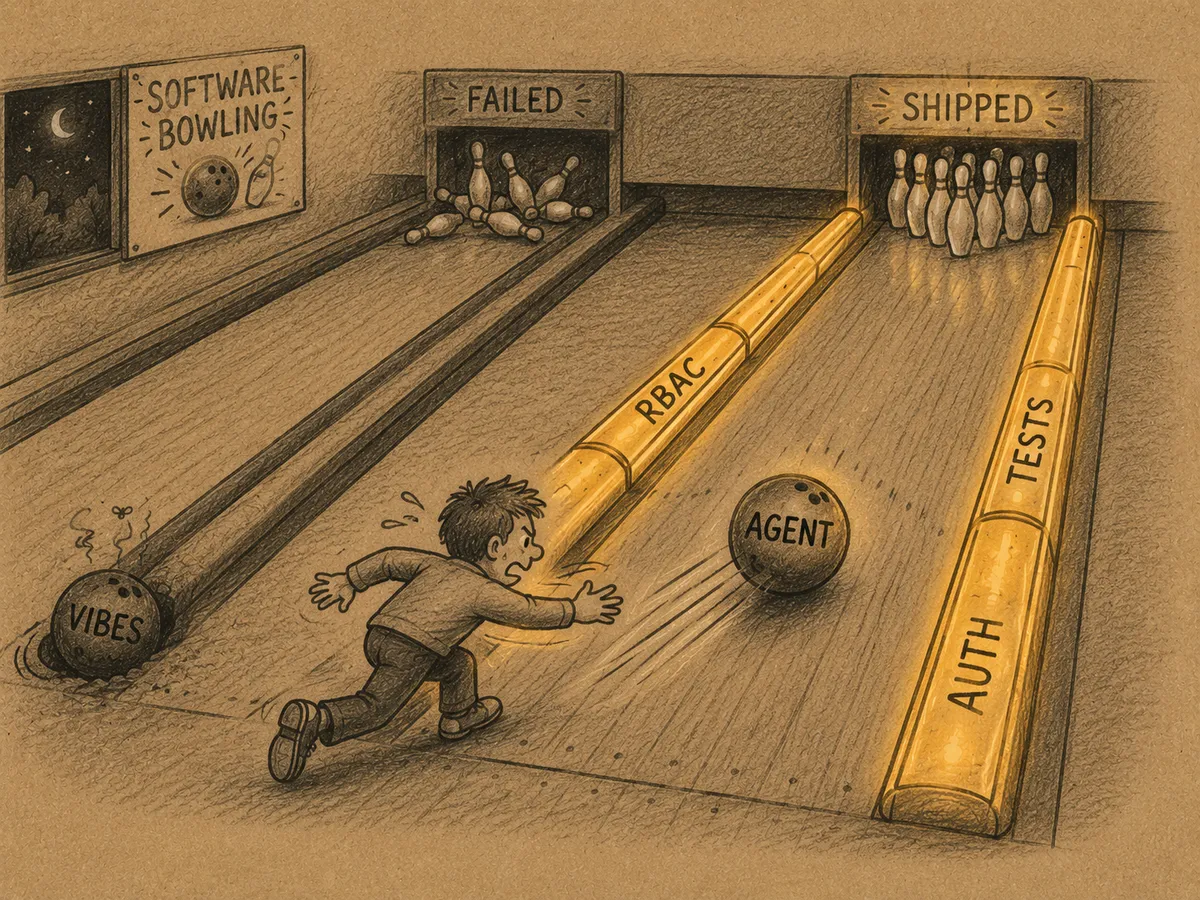
My three kids were demons at ten-pin bowling with the bumpers up as six-year-olds. Strikes, spares, maybe a little victory shimmy. Take the bumpers down and it was gutter, gutter, gutter, followed by a sulk and a cry of ‘it’s not fair’.
The bumpers are the reason the ball ends up roughly where it should, the reason the game is fun, and the reason a six year old can throw it as hard as they like without it ending in tears two lanes over.
Vibe coding takes the bumpers off
The internet’s favourite phrase for building with AI is “vibe coding”. You describe what you want, you let the model run, you see what comes out. Vibes only. Vibe coding has had its moment, but the name rather gives the game away. It implies no guardrails and an acceptance of whatever quality falls out. That’s fine for a throwaway but reckless for anything that matters.
For anything real-world, I would rather do agentic engineering. Same speed. Same letting-the-agent-run in loops, harnesses against your context, but with the bumpers up.
Dataverse has built in bumpers
This is where Dataverse is a great place to let an agent loose.
Dataverse is the data platform underneath Power Platform and Dynamics, and it comes with some guardrails built in. Authentication. RBAC, Validation, Rules. Let an agent run against it and there is a whole category of catastrophe it simply cannot cause, because the platform refuses. The bumpers are bolted to the lane.
Compare that to an agent let loose with the keys to production, a stack it’s picking on the fly and nothing to stop it. That same model is likely to give you a wildly different blast radius.
None of this is magic. Bumpers do not make a good bowler, but they stop a bad throw becoming a disaster. The grounding still has to be right, because garbage in is still garbage out, just delivered faster and with more confidence. The agent will create the table, the plugin, the JavaScript, without you hand-cranking a line. Whether it writes a good one should be a question of grounding and guardrails, not luck or your reliance on a version of Claude or Codex.
AFK or in the loop
All of which decides the only question that really matters day to day: how far can you step away?
There are two modes. AFK, away from keyboard, is when you let the agent run on its own and go and do something else. HITL, human in the loop, is when you stay and approve each move. The height of your bumpers decides how far you can step away.
On a recent project I built end to end through code, I happily let the agent build the forms and the views away from keyboard, because the tooling, platform and harness provided a low likelihood of producing something broken. I stayed firmly in the loop for the security model, because deciding who can see and do what is a judgement about trust and blast radius, and no bumper saves you from confidently wiring up the wrong permissions. Strong guardrails buy you AFK. Weak guardrails keep you HITL whether you fancy it or not.
Mind the doorman
Rory Sutherland calls this the doorman fallacy: a hotel automates away its doorman because the job title said “opens doors”, and only afterwards discovers everything else he did - greeting guests, hailing taxis, keeping an eye on the street. The human steps we are itching to remove were often doing more than their job title - catching the edge case, carrying the accountability, noticing the thing that was subtly off. So before you let a step go fully AFK, consider what else it was doing. Some of your human-in-the-loop moments might be holding the thing up. Remove them as ‘friction’ and you find out which ones.
Did you find this post helpful?
A little support goes a long way in helping me create more free, in-depth content like this.