The One-Armed Bandit
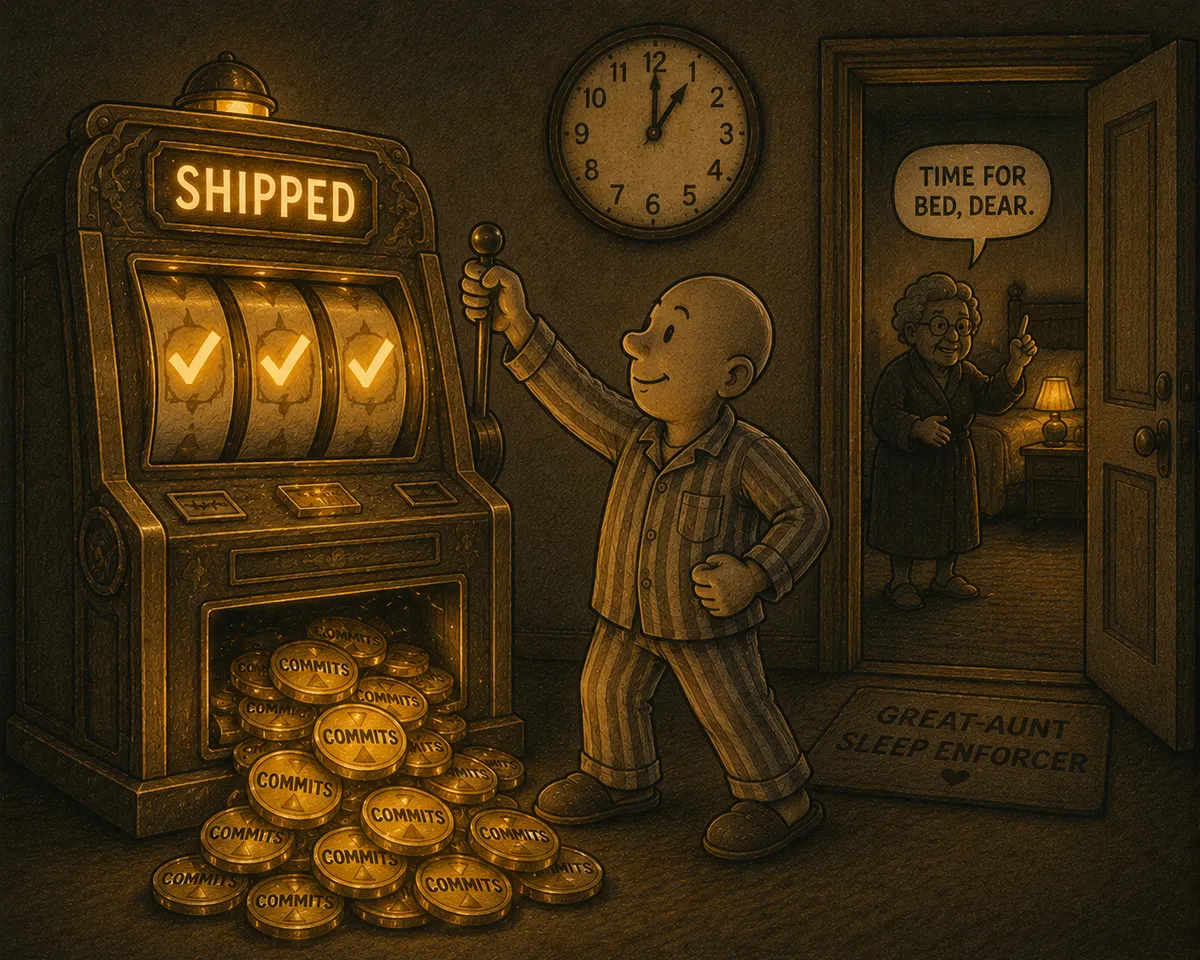
One of my earliest childhood memories is of my great-aunt at a one-armed bandit in Olympia amusement arcade in Bundoran. A seaside town, a dim arcade, the smell of chips, and her at the machine, feeding it and pulling the handle while it spat out an endless stream of 2p coins. I was mesmerised by the machine that kept giving.
Working with agentic AI feels like playing that machine, and that is not necessarily a compliment.
A machine that pays out every time
Once you learn how to feed one, how to ground it, how to set up the harness so it has what it needs, the AI pays out (almost) every time. You ask for a thing and it builds the thing. You ask for another and it builds that too. And like my great-aunt at the one-armed bandit, it becomes very hard to step away.
The reliability is what makes it worse, not better. A real slot machine pays out only sometimes, and psychologists will tell you that an unpredictable reward is precisely what hooks gamblers. You would think a machine that pays out almost every time would be easy to put down. It is the opposite. Every win lands, and in the glow of it you can already see the next thing you could build, so you reach for the handle again and again.
Racing the window
Then the tooling adds the one ingredient the compulsion was missing. Scarcity.
These models come with usage windows. A five-hour window here, tokens burning fast on full-speed mode, credits that reset on a clock you did not set. Now you are not enjoying a machine that pays out - you are racing a meter. A deranged little logic creeps in to your subconscious thinking - “hmm, my window resets at one in the morning. I have credits sitting there unused. It would be a waste not to spend them.”
So you sit up, you feed the machine, you max out the window, and you go to bed later than you should with the warm, hollow satisfaction of a job that was never going to end. I have done it more nights than I will admit. It does not feel like overwork and that is the trap. It feels like winning.
A new kind of burnout
We have built, for the technically curious, a slot machine that pays out in completed work. And because it pays out in completed work, it is almost impossible to feel guilty about it. Gambling at least has the decency to feel like a vice. This feels like being productive, so you never tell yourself to stop.
The old burnout was grinding through too much tedious work. I think there is a new one coming, and it is stranger: the compulsion of too much rewarding work, with a meter running. Is managing agents a new kind of burnout? I recognise the shape of it, and the shape is my great-aunt at that machine, and somebody having to take her by the elbow and back to the car.
The meter is the other half
The meter, by the way, is not an accident, and it might be the other part of why many in tech are hunched over laptops at midnight.
The economics have not settled. We are, in effect, running powerful agents on individual allowances, because nobody is quite sure what they cost or who should pay. OpenAI and Anthropic are reportedly losing money hand over fist. Inside the big technology companies, “tokenmaxxing” - burning through tokens because spending them is taken as a sign you are doing the future - is a flex. In the real world where money matters, it is a glance at the bill. Copilot, Claude, Codex, each have their own prices and quite different limits, and all of them still close enough to the frontier of cost that you feel every pull of the handle.
Last orders
My great-aunt’s one armed bandit ran out of coins eventually. But my laptop has no closing time and no one to take it to the car. It will pay out for as long as I keep feeding it, and it is perfectly happy to keep me company at one in the morning. So I have had to learn to do the thing the arcade used to do for me and call last orders on myself.
Did you find this post helpful?
A little support goes a long way in helping me create more free, in-depth content like this.